
Why Some Epoxy Floors Fail (and What Makes the Difference)
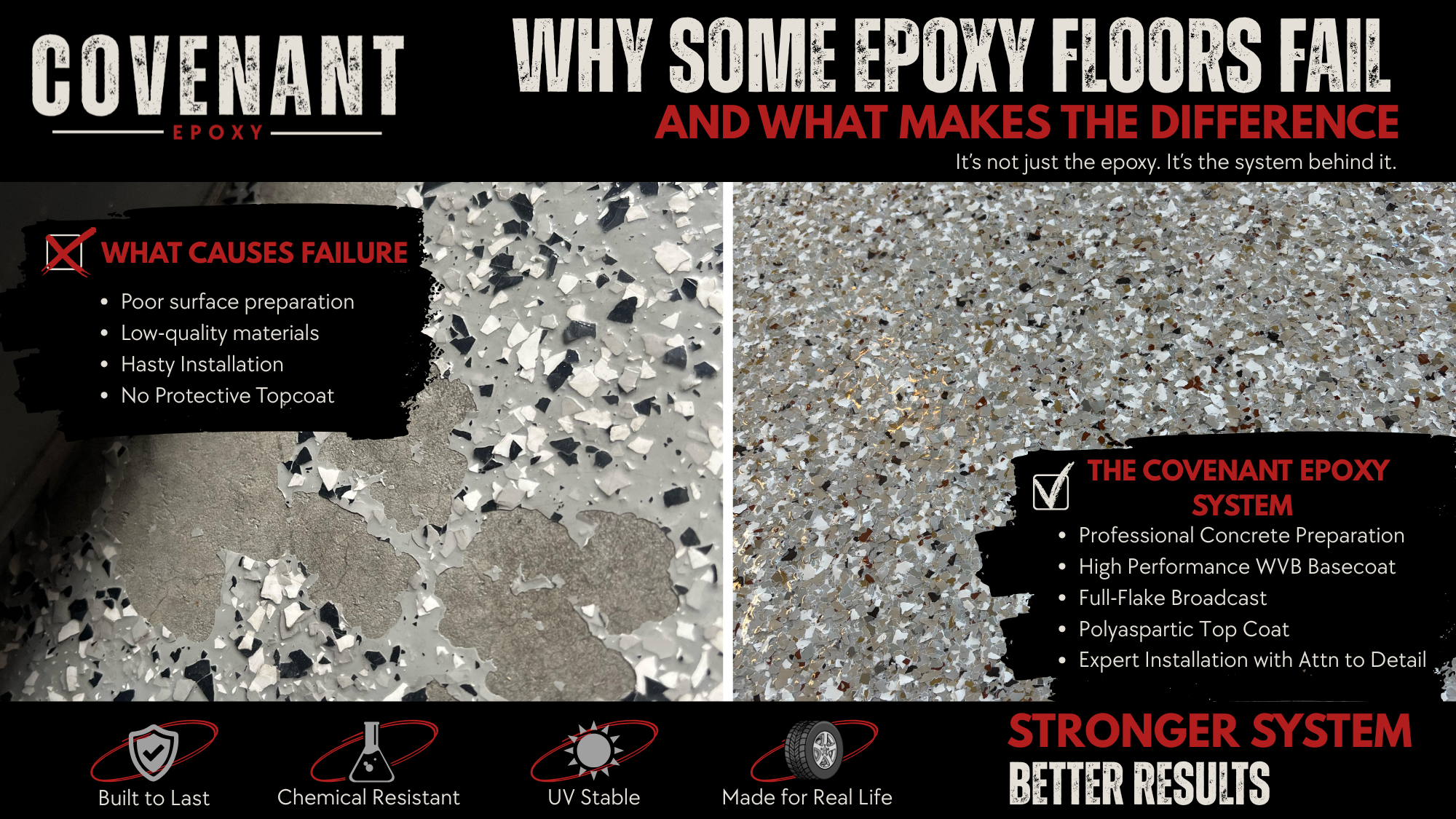
Not all epoxy floors are built to last. If you’ve seen peeling, chipping, or fading, the problem usually isn’t epoxy itself—it’s how it was installed. Here’s what causes failure and what makes the difference.
If you’ve ever walked into a garage and noticed peeling edges, dull patches, or flakes lifting from the surface, you’ve seen what happens when an epoxy floor doesn’t hold up.
For something that’s often marketed as “long-lasting” or even “permanent,” it can be surprising how quickly some coatings begin to break down. The truth is, epoxy flooring itself isn’t the problem. Most failures come down to how it was installed, what products were used, and whether the right steps were taken from the beginning.
A garage floor is only as strong as the surface it’s bonded to. Concrete may look solid, but it’s porous and often filled with dust, oils, and residue that you can’t always see. If that surface isn’t properly prepared, the coating doesn’t truly bond—it just sits on top. Over time, that’s when you start to see peeling, bubbling, or sections lifting under pressure.
Proper preparation isn’t quick, and it isn’t optional. It involves mechanically grinding the concrete to open its pores, repairing cracks, and removing anything that could interfere with adhesion. When that step is rushed or skipped, even a good product won’t last.
Moisture is another hidden factor that can quietly work against a coating. Concrete naturally holds moisture, and in a place like Florida, that’s even more true. As that moisture moves through the slab, it can push up against the coating from underneath. When a system isn’t designed to handle that, it often leads to bubbling or separation over time.
Then there’s the quality of the materials themselves. Not all epoxy is created equal. Many of the products found in store-bought kits or low-cost installs are thinner and less durable. They may look great right after application, but they tend to wear down faster, scratch more easily, and lose their finish far sooner than expected.
One of the most overlooked pieces of the system is the topcoat. Without a strong protective layer, the floor is left exposed to everything from hot tires and dropped tools to UV light and chemical spills. That’s usually when fading, dullness, and surface wear start to show.
Even when decent materials are used, the installation itself still matters. Applying coatings too thin, rushing cure times, or skipping steps to move faster can all shorten the life of the floor. This is where experience and attention to detail really make a difference.
At Covenant Epoxy, we approach each floor as a complete system rather than a quick coating. It starts with thorough mechanical preparation to create a proper bond with the concrete. From there, a high-quality epoxy base coat forms the foundation, followed by a full flake broadcast that adds both durability and a clean, uniform look.
The final layer is a polyaspartic topcoat, designed to protect the floor from UV exposure, scratches, and daily wear—especially in Florida’s climate. It’s this combination of preparation, materials, and careful application that allows the floor to hold up over time, not just look good on day one.
A failing epoxy floor can be frustrating, but it’s rarely unavoidable. When the process is done correctly from the start, the result is a surface that’s built to last and made to handle real, everyday use.
If you’re considering upgrading your garage, it’s worth taking the time to understand what goes into a system that actually holds up. Done right, it’s not just a cosmetic improvement—it’s a long-term investment in your space.
And when it’s done right, you don’t have to think about it again.